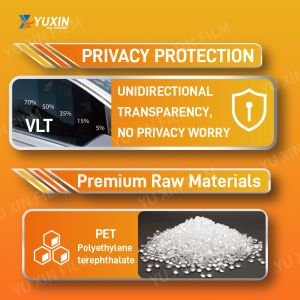
WHY INSTALL CHAMELEON WINDOW
Installing automotive color-changing window film (usually referring
to photochromic or electrochromic film) brings a unique dynamic
aesthetic and intelligent practical experience to vehicles.
In terms of color appearance, its biggest advantage lies in its
dynamic adaptability. The film's color can automatically or
manually adjust its depth according to sunlight intensity. It
darkens significantly in strong light to enhance privacy and
shading, while restoring high light transmittance in low light,
achieving multiple visual effects with a single film, balancing
fashion and regulatory requirements.
Regarding materials and heat insulation performance, high-end
color-changing films often utilize composite intelligent materials
and precision optical coatings. It not only maintains the basic
characteristics of high-quality window films—such as effectively
blocking infrared and ultraviolet rays for excellent heat
insulation, sun protection, and interior protection—but also
further optimizes thermal management through an intelligent dimming
layer. Its heat insulation performance is more proactive and
adaptive, dynamically responding to environmental changes, thereby
improving visual comfort while delivering smarter and more
efficient energy-saving effects.
What are the differences between different types of window film?
Type | Core Structure Characteristics | | Applicable Scenarios |
Dyed Film | Only dye layer + glue layer | 1-1.8mil | Low-end model, limited budget |
Metallic Film | Multilayer metal + polyester substrate | 2-3mil | In high temperature areas, pursue high insulation |
| Nano Ceramic Film | Nano-ceramic particles + PET layer | 2-4mil | High-end models with signal penetration |
| Privacy Film | Dark dye layer + one-way perspective technology | 2-3mil | Commercial/luxury cars, privacy oriented |
| Chameleon Film | Colorful gradient, highly personalized | 2-3mil | Commercial/luxury cars, privacy oriented |
The main structure of car window film
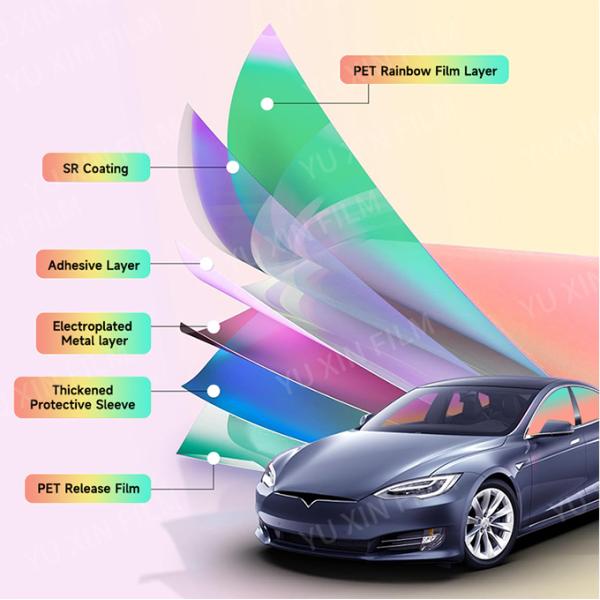
Chameleon window film adopts a multi-layer composite structure:
surface anti-scratch coating + nano metal oxide interference layer
(TiO₂/SiO₂) + PET substrate (strength guarantee) +
pressure-sensitive adhesive layer. It achieves dynamic color
changing effect through the principle of optical interference,
combining wear resistance and color performance.
What are the benefits of car window film?

UV Protection: High-quality photochromic films block up to 99% of
UV rays, effectively preventing sunburn and interior aging. Some
products are UV400 certified, blocking all UVA and UVB rays.
Thermal Insulation: Utilizing a multi-layer metal or ceramic
coating, they block 70%-90% of infrared rays, reducing temperatures
by 5-10°C in summer and significantly reducing air conditioning
energy consumption, offering superior energy efficiency compared to
standard films.
Lifespan: High-end magnetron sputtering products: 6-8 years
(scratch and abrasion resistant, with excellent color stability).
Maintenance: Avoid scratching with hard objects. Clean with a soft
cloth and a neutral cleaner to extend the lifespan by 20%-30%.

How does chameleon film works?
Chameleon film creates its color-shifting effects through
structural optics, not pigments. It contains microscopic, layered
coatings (often alternating nano-scale films of materials like
titanium dioxide and silicon dioxide). These layers act like a
photonic palette, manipulating light via three key processes:
Light Interference: When light hits the layered structure, waves
from different layers overlap. Some wavelengths reinforce each
other (making colors visible), while others cancel out, depending
on the layers’ thickness and the angle of light.
Angle-Dependent Reflection: As the viewer’s angle or light source
changes, the path length of light through the layers shifts. This
alters which wavelengths are reflected, causing colors to morph
(e.g., blue to green or gold to purple).
Diffraction & Iridescence: The nano-structure scatters light into
its spectral components, creating a rainbow-like effect similar to
butterfly wings or oil slicks.
In short, chameleon film is a light-responsive optical device,
using physics—not chemistry or heat—to produce dynamic, shimmering
hues that adapt to light and perspective.

Chameleon Film and Environmental Sustainability
Chameleon film aligns with eco-conscious goals through thoughtful
design and production practices. Many variants use recyclable
polyester bases, reducing plastic waste at end-of-life, while
water-based, solvent-free adhesives minimize VOC emissions during
manufacturing and installation. Some manufacturers employ
energy-efficient nano-layering processes that cut carbon footprints
compared to traditional film production. Though not all chameleon
films are fully biodegradable, their long lifespan (8–12 years)
reduces replacement frequency, lowering resource consumption.
Additionally, their solar control capabilities indirectly support
sustainability by cutting HVAC energy use, reducing carbon
emissions from buildings and vehicles. While niche in the green
film market, chameleon film’s blend of durability, low toxics, and
energy-saving potential makes it a progressively eco-friendly
choice for design-forward projects.

Color variety selection
14 colorful chameleon window films available in multiple colors,
with light transmittance ranging from 20% to 90%. Customizable with
high sun and heat protection! Inquiries welcome. Professional
installation available. 5-10 year warranty.

As a vertically integrated manufacturer, we control the entire
production process—from functional masterbatch formulation to base film extrusion, coating application, slitting, and finished product assembly. This seamless supply chain ensures superior quality control, cost
efficiency, and rapid customization for all paint protection film
(PPF) solutions.
Equipped with top-tier fully imported TPU film production lines, we combine global precision with independent R&D upgrades to
refine equipment performance. Our advanced machinery enables us to
produce high-quality TPU base films with exceptional clarity,
durability, and dust-free surfaces—critical for premium paint
protection.


Our multidisciplinary team includes:
- Thermoplastic Elastomer Polymer Specialists: Optimizing material properties for superior adhesion, UV
resistance, and self-healing performance.
- Mechanical Equipment Engineers: Ensuring precision in every production stage, from extrusion to
coating.
- Production Technology Experts: Mastering processes to achieve uniform thickness, flawless
surface finish, and consistent product quality.
- Dedicated QC Professionals: Conducting rigorous pre-shipment inspections to guarantee
alignment with sample standards and dimensional accuracy (e.g.,
film length compliance).
Before shipment, our QC team meticulously verifies:
- Product-Sample Consistency: Ensuring every batch matches the approved prototype in texture,
thickness, and performance.
- Spec Compliance: Checking film length, width, and mechanical properties to meet
exact customer requirements.
- Dust-Free Purity: Maintaining cleanroom-grade production environments to eliminate
surface imperfections.
With a large-scale warehouse stocked with TPU paint protection film, automotive window film, architectural
decorative film, TPU windshield film, and colored PPF, we enable immediate order fulfillment. Our streamlined logistics ensure your products are delivered
promptly, reducing lead times and enhancing supply chain
reliability.


FAQ:
A1: The car's windshield and weather will affect the installation
effect of the chameleon
A2: Not recommended! It requires a dust-free environment,
specialized tools, and a heat gun to set the film. DIY applications
can easily cause bubbles and warping.
A3: Use a neutral detergent and a soft cloth to clean. Avoid using
alcohol or steel wool to prevent scratches on the coating.
A4: Vacuum coating technology deposits nanoscale metal oxides (such
as TiO₂ and SiO₂) onto a PET substrate. When light passes through,
it interferes with the film and reflects different colors.
A5: Many variants use recyclable materials (e.g., polyester bases) and low-VOC adhesives. Some brands offer energy-efficient production processes, though
full biodegradability is rare.
A6: Light colors will not have an impact, but dark colors may
slightly reduce visibility at night, subject to local light
transmittance regulations. For windows with a VLT of 20% or less,
it is recommended to install it on the side windows.